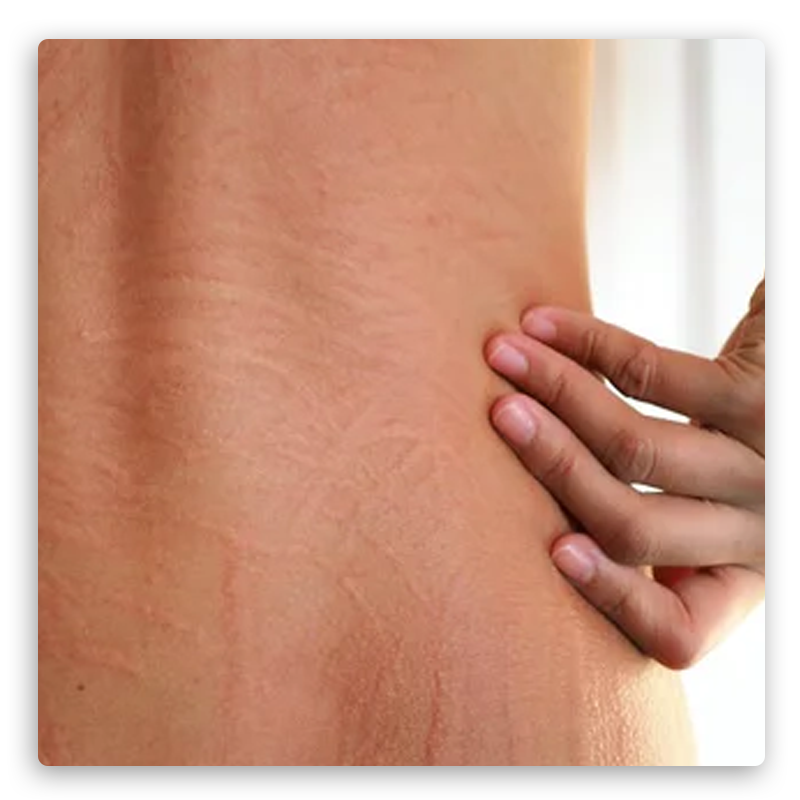
Dermographism belongs to the group of physical urticarias, which are rashes triggered by physical stimuli. These rashes disappear once the stimulus is removed from the skin. Physical urticarias are usually chronic and last for more than 6 weeks. Their prevalence ranges from approximately 0.5% to 2% of the population. Physical urticarias are classified into various types:
Urticaria due to mechanical causes:
- Dermographism
- Delayed pressure urticaria
- Vibratory urticaria
- Urticaria due to thermal stimuli
- Cold urticaria
- Heat urticaria
- Solar urticaria (UV radiation)
|
Dermographism
Dermographism is the most common form of physical urticaria and is often discovered incidentally during examinations for other conditions. It appears when pressure or friction is applied to the skin, leading to the formation of red wheals. In most cases, the cause is unknown, and it is therefore considered idiopathic. However, in some cases it may be secondary, caused by infections, medications, or hormonal changes (e.g., pregnancy, menopause, thyroid disorders).
Dermographism is classified into:
- Asymptomatic: Rash appears without symptoms or sensation. This is the most common form.
- Symptomatic: Itching occurs before the rash appears, which is usually worsened by scratching.
- Delayed: The rash appears later and lasts for several hours, accompanied by itching and a burning or painful sensation.
Pathogenesis
The pathogenesis of dermographism remains unclear, but it is believed that mast cells in the skin release increased amounts of histamine without the presence of an antigen. Even minimal pressure or friction causes mast cells to degranulate, releasing histamine, which leads to redness and swelling of the skin.
Diagnosis
Diagnosis is simple and is made by applying friction or pressure to the skin. Within a few minutes, the rash appears in the form of lines, words, or shapes, depending on the applied stimulus.
Treatment
Asymptomatic dermographism: No treatment is required, and symptoms usually resolve on their own.
Symptomatic dermographism: Avoid pressure or friction that triggers the rash. Treatment includes antihistamines (H1 or combined H1 and H2) to relieve symptoms. If dry skin is present, moisturizing creams or lotions are recommended.
Course and Prognosis
Dermographism may appear and disappear suddenly. Apart from discomfort and itching, it does not cause serious complications. The average duration is approximately 6 years, although about 5% of patients may experience symptoms throughout their lifetime. Symptoms may worsen due to heat, cold, hormonal changes, or physical/psychological stress.